
Appanoose County Court Records After Arrest
After an Appanoose County jail arrest, the jail custody path and the court-record path separate. The jail receives and holds the person under lawful authority. The prosecutor reviews reports and determines what charges to file. Once a case opens, court records carry the case number, filed counts, hearing schedule, bond conditions, no-contact orders, warrants, amendments, dismissals, pleas, trial settings, and dispositions.
That distinction prevents a common search error. Jail booking information may show why a person was brought into custody, but it is not the final court record. Filed charges may differ from booking charges. For current custody and booking details, use Appanoose County jail inmate records. For booking photos, use Appanoose County jail mugshots. For formal charges and case status, use the court record.
Find Appanoose Court Records After Arrest
The official entry point for public case lookup is Iowa Courts Online. The system is frame-based, and the research environment did not fully capture every field, but official labels and snippets identify it as the state court electronic docket and public case-search service. Use the arrested person's full name, case number if known, and Appanoose County or District 8 filters when the interface allows them.
- Get the person's exact name, date of birth clue, and arrest or booking date from paperwork or the jail.
- Search Iowa Courts Online by party or defendant name, then narrow by county and case type when possible.
- Open matching criminal cases and compare filing dates with the arrest date.
- Read the charge list, bond entries, hearing dates, and status for each count.
- For documents not visible online, contact the Appanoose Clerk of District Court or use Judicial Branch records-request procedures.
The official court entry page captured for this project is shown below from Iowa Courts Online.
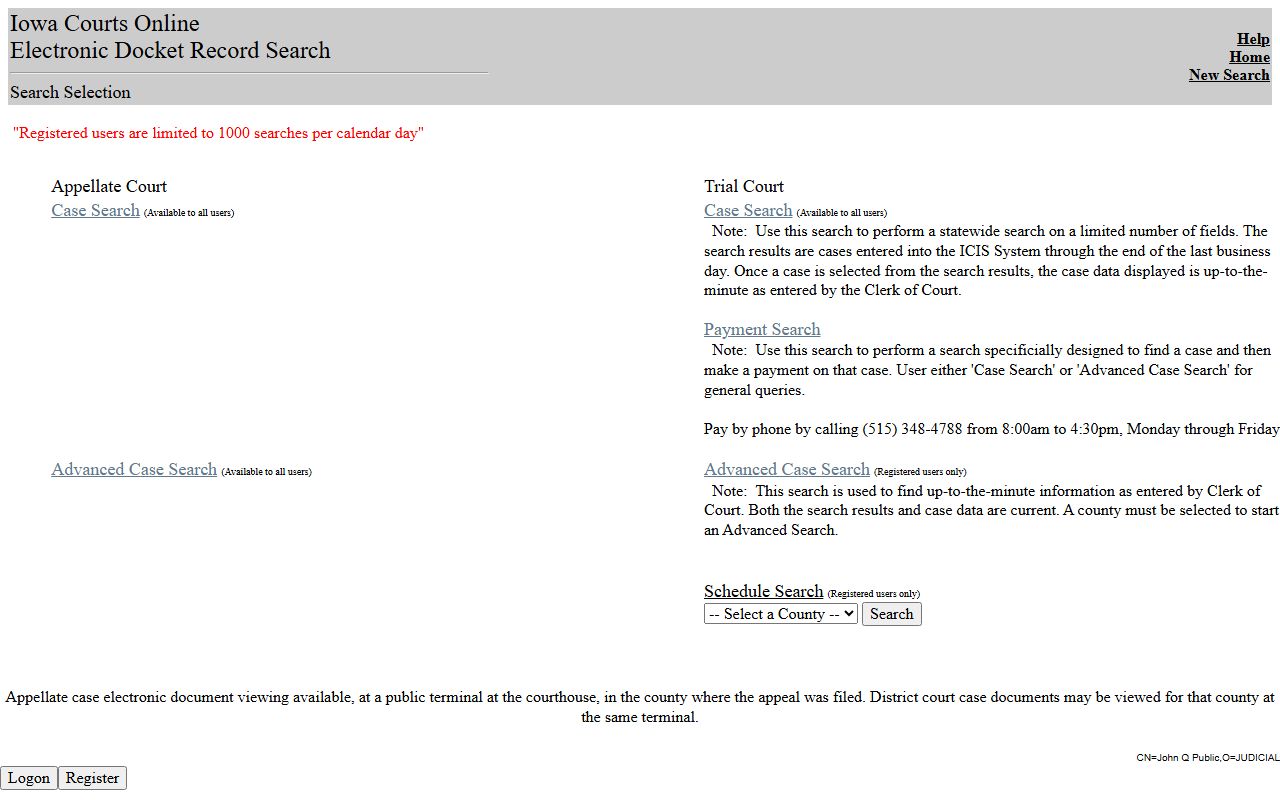
The court system is the charge and case source; it is not an Appanoose County jail roster.
Appanoose Court Case Search Fields
The research could not inspect the full frame-body form, but official references and page labels identify common court-search paths. A case number is best when it appears on jail, bond, or court paperwork. A party-name search is the usual fallback. If the name is common, use middle name, date-of-birth clues, case filing date, charge type, and county filters to avoid matching the wrong defendant.
| Field Label | Type | Required | Notes |
|---|---|---|---|
| Case Search | Link / search mode | n/a | Official trial-court case-search workflow through frames. |
| Party name | Search field | Unspecified | Use defendant name and narrow by other facts. |
| Case number | Search field | Unspecified | Best when known from paperwork. |
| Attorney name | Search field | Unspecified | Identified in official/public guidance. |
| Case type / group | Filter | Unspecified | May help isolate criminal records. |
Appanoose County Prosecutor Records
Iowa uses county attorney terminology rather than district attorney. The Appanoose County Attorney is Ty Stewart, with Assistant County Attorney Alan M. Wilson. The county attorney's office is at 201 N. 12th, Centerville, IA, and the phone number listed in the county research is (641) 437-7178. The prosecutor's role is to decide what formal charges to file after reviewing law-enforcement reports.
The prosecutor may file the same charge seen at booking, file a different charge, add counts, reduce counts, dismiss a count, or resolve the case through plea, trial, deferred judgment, dismissal, or another disposition. Victim notification can also intersect with the county attorney because IDOC says victims register through the County Attorney's Office where the crime was prosecuted when DOC notification is involved.
Charging Documents After Arrest
A criminal court record normally starts with a charging document. The exact path depends on the offense level and procedure, but the key point is the same: the court record is the filed accusation, not just the booking label. The following terms describe common charging-document concepts, with Appanoose County cases handled through Iowa's district court system.
| Document | What It Does | Why It Matters |
|---|---|---|
| Complaint | Starts or supports a criminal accusation in court. | Often the first court filing after arrest. |
| Information | Prosecutor-filed charging document. | May replace or refine the initial arrest charge. |
| Indictment | Grand-jury charging document. | Used in some serious criminal matters. |
Appanoose Charge Status Terms
Case status can change several times after a jail arrest. A charge may start as pending, then be amended or reduced. A count may be dismissed while another count continues. A deferred judgment can have a different public-record effect than a conviction. Always read each count, not just the case caption, because a single case can contain more than one result.
| Status | What It Means |
|---|---|
| Pending | The case or count is not finally resolved. |
| Amended | The filed charge changed after the original filing. |
| Reduced | The charge changed to a lesser offense or level. |
| Dismissed | The count or case ended without a conviction on that charge. |
| Deferred judgment | An Iowa disposition that may be discharged, with DCI release rules differing by record type. |
Bond After Appanoose Arrest
No official Appanoose County bond instruction page was located on the sheriff or jail site. Use the jail for immediate custody questions and the court or clerk for filed-case bond conditions. The Appanoose Clerk of District Court is listed at 201 N. 12th St., Centerville, IA 52544, phone (641) 856-6101. Bond is a court condition, and another agency hold may prevent release even when a local bond appears satisfied.
| Bond Type | Meaning |
|---|---|
| Cash bond | Money deposited as ordered by the court; verify posting location and hours locally. |
| Surety bond | Bond through a licensed surety or bondsman where accepted. |
| Own recognizance / PR | Release based on a promise to appear and comply with conditions. |
| No-bond hold | Release is not authorized until a court or holding agency changes the status. |
| Hold for another agency | A county, DOC, federal, or ICE hold can delay release. |
Warrants and Court Records
No official Appanoose County active-warrant search page was located on the county or sheriff site, and the Appanoose County Sheriff Iowa app store listings did not advertise a warrant lookup. Warrant questions should start with the sheriff's office at 641-437-7100 or the jail at (641) 437-7106 if the person may already be booked. Iowa Courts Online may show failure-to-appear events, bench warrants, bond forfeitures, or warrant-related docket entries when public.
Warrant terms need care. An arrest warrant authorizes arrest. A bench warrant is issued by a judge, often after failure to appear. A search warrant is usually tied to evidence and may remain confidential during an investigation. A fugitive or hold warrant may involve another jurisdiction. Once a person is arrested on a warrant and booked into Appanoose County Jail, the custody question becomes a jail question and the case question remains a court question.
Charges vs Convictions
An arrest and a charge are not a conviction. A charge is an accusation filed or pursued in court. A conviction is a final result based on a plea, verdict, or qualifying adjudication. Court records after an Appanoose County jail arrest should be read with that distinction in mind, especially when a background check or employment question is involved.
| Charge | Conviction | |
|---|---|---|
| Stage | Accusation or filed count. | Final adjudication based on plea, verdict, or judgment. |
| Can change? | Yes, it may be amended, reduced, or dismissed. | May be appealed, deferred, expunged, or otherwise affected by law. |
| Search source | Court docket and charging documents. | Court disposition and criminal-history records. |
Sealed vs Expunged Records
Iowa public access is broad under chapter 22, but it has exceptions. Juvenile records, sealed records, protected information, active investigative material, and some confidential law-enforcement records may not be visible to the public. Expungement is a legal process that can remove or limit qualifying records. Sealing and expungement are not the same thing, and eligibility depends on the case type and final disposition.
| Sealed | Expunged | |
|---|---|---|
| Public visibility | Hidden or restricted from ordinary public access. | Removed or treated differently under the applicable court order. |
| Who decides | Court order or law. | Court order or statute-based process. |
| Search impact | A public search may show less detail. | A public search may omit qualifying records. |
Iowa DCI Criminal History
A court docket is not the same as a statewide criminal-history record. The Iowa DPS/DCI criminal-history record check page lists online, mail, fax, email, and in-person request channels. The research states the fee is $15 per last name and phone requests are not accepted. DCI results have their own release limits, so do not assume every court event appears the same way in every system.
The screenshot below comes from the official DCI criminal-history page and shows the state request channel, not an Appanoose County jail record.

Use DCI when the request is for statewide criminal-history information rather than a local jail booking or court docket.
Restricted Appanoose Court Records
Iowa Code chapter 22 gives public access to records unless an exception applies, and section 22.7 lists confidential-record categories. In practice, Appanoose County court records after a jail arrest may omit or restrict juvenile matters, sealed cases, protected victim or witness information, medical details, some active investigative records, and information made confidential by court order. If an online case search appears incomplete, contact the clerk or use the Judicial Branch public-records request channel.
Important: Do not use informal court or jail searches for FCRA-covered employment, credit, insurance, or housing decisions.